A powder-coated frame looks the same on day one whether it was prepared in seven stages or three. The difference appears after a year of mopping, chair stacking and cleaning chemicals — and by then the container is long gone.
Colour is the easiest thing to match and the least useful thing to check. What decides the life of the finish is what happened before the powder went on, and what happened in the oven afterwards.
Why coatings fail
Almost every coating failure in school furniture is one of four things.
Poor adhesion. Oil, dust or oxide left on the steel before coating. The film looks perfect and lifts in sheets when a chair is dragged.
Under-cure. The powder melts and flows but does not fully cross-link. The finish feels slightly soft, chips easily and loses gloss in cleaning.
Thin coverage at edges and recesses. Powder is attracted to flat surfaces. Sharp edges, weld seams and inside corners receive less, and that is exactly where corrosion starts.
Mechanical damage during packing and transit. Not a coating defect, but it becomes one when there is no matching touch-up in the carton.
Pre-treatment is the product
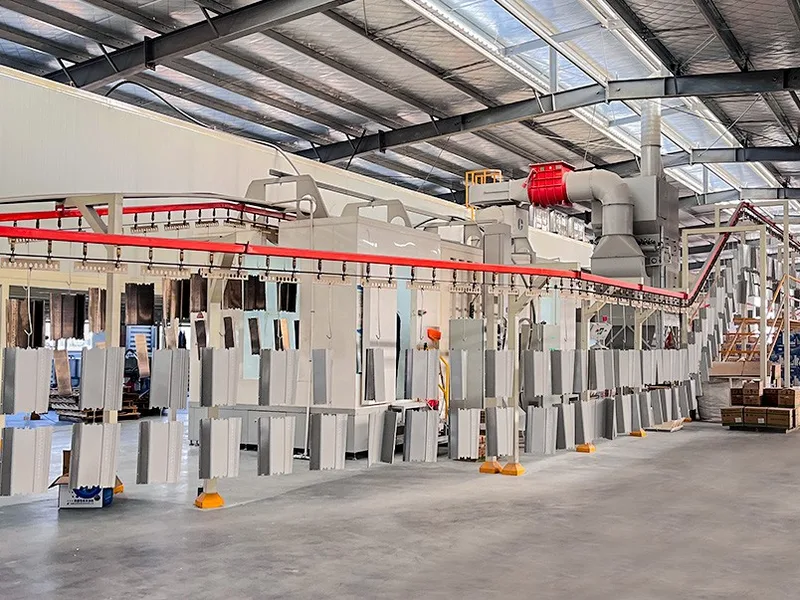
The coating line is only as good as the wash before it. Industrial pre-treatment for steel furniture typically runs through several stages: alkaline degreasing, rinse, a conversion coating such as zinc phosphate or zirconium, further rinses, a demineralised rinse and drying.
The purpose is not to clean the frame in the everyday sense. It is to create a surface the powder can bond to chemically, and to remove everything that would sit between the two.
Ask the supplier to describe the pre-treatment stages and the control points: bath concentration, temperature, rinse water quality and drying before coating. A stage count alone does not establish the performance of the finish.
If the answer is "we clean it well", the question has not been answered.
The powder is not just colour
Two frames can carry the same RAL number and different chemistry.
Epoxy-polyester hybrid is the common choice for indoor steel furniture. It flows well, adheres strongly and resists cleaning chemicals. It is not the best choice for long outdoor exposure.
Polyester systems are more UV-stable and are used where furniture sits in daylight or outdoors. For a classroom, UV stability is rarely the limiting factor; adhesion and edge coverage are.
Ask what powder type and grade the supplier uses, not just the colour code. A premium powder on a badly prepared frame still fails; a standard powder on a well-prepared frame often performs better than the reverse.
Cure, thickness and the numbers that matter
Powder coating is cured in an oven, and the cure schedule comes from the powder manufacturer's datasheet — usually a combination of temperature and time at metal temperature, not just oven air temperature.
Thickness is commonly specified in the range of 60–80 µm for furniture, measured on the flat faces. The number is less important than consistency: a film that is 90 µm on the front panel and 40 µm inside a corner is not a 90 µm coating.
Ask for the specification the supplier works to, and how thickness is checked. A mill-certificate-style report is less useful than a simple record of measurements per batch.
Where the coating hides
Two areas deserve a closer look.
Cut tube ends and weld seams. Powder does not wrap neatly around a sharp edge. If the edge is burred or the weld is porous, the film is thin exactly where water sits.
Inside corners and recesses. Electrostatic attraction creates a Faraday-cage effect: recessed areas receive less powder. A supplier who understands this adjusts the gun positions and checks the recesses, rather than turning up the voltage and hoping.
On school furniture, the most abused area is usually the lower frame — the part that meets wet floors and chair legs. Ask for a photo of a coated leg end, not a photo of a whole desk.
What to ask before you order
A short list that separates a coating specification from a colour choice:
- What pre-treatment stages run before the powder booth, and how are they controlled?
- Which powder chemistry and grade, from which manufacturer?
- What cure schedule is used, and is it checked at metal temperature?
- What thickness range is specified, and where is it measured?
- Which adhesion and corrosion tests are run, to which standards, and how often?
- Can you send the test report for the same powder and pre-treatment as our order?
The last question is the one that matters. A salt-spray report for a different powder on a different line proves very little.
Field checks you can run
You do not need a lab to spot a weak finish.
Look at an edge. A well-coated cut edge is covered and smooth. A thin edge shows a faint line of substrate or a rough, almost sandy texture.
Request adhesion evidence. Ask which test method was used and which coating system and sample the report covers. A casual tape check is not a substitute for a defined test.
Ask how cure is verified. Request the powder manufacturer's specified cure schedule and the supplier's process records. Use only the cleaning products recommended for the finished furniture.
Review impact performance. If impact resistance matters to the project, agree a recognised test method and acceptance criteria before testing an approved sample.
Check the touch-up. If the supplier cannot supply a matching touch-up paint, the finish will look tired after the first installation.
Why this matters commercially
A coating failure is rarely a warranty claim in year one. It shows up as rust bloom at the leg ends in year two, chalking on the sunlit side, or paint lifting where the cleaner scrubs hardest. By then the school is not comparing suppliers — it is deciding whether to reorder from the same one.
Specify the process as well as the colour. Ask for the pre-treatment stages, the powder type and the cure schedule, then check that the proposed evidence covers the coating system for your order.
If you are comparing frames for a tender, send us the model and the environment — indoor classroom, coastal site, outdoor canteen — and we will send the coating specification and the test reports we hold.