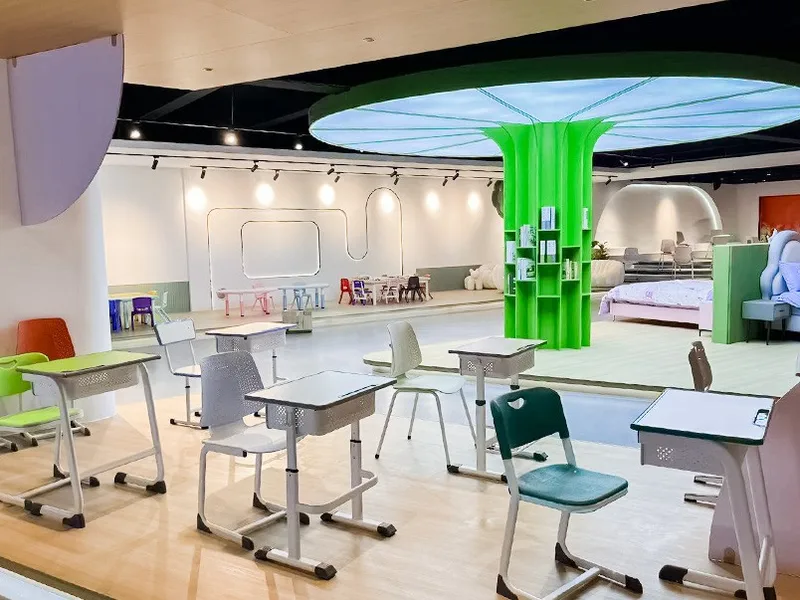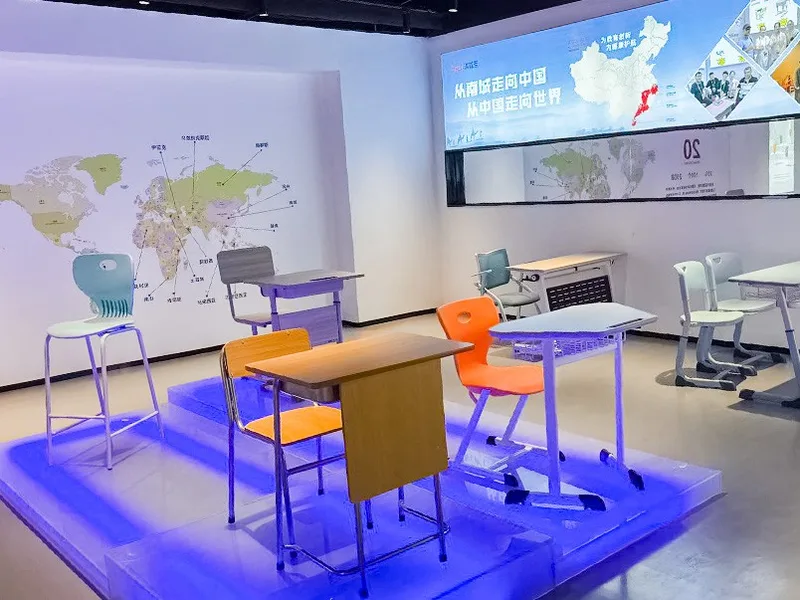
On a quotation, an adjustable desk looks like the expensive option. It usually is — per unit. The comparison changes when you stop pricing furniture and start pricing a school.
A fixed desk fits one size band. A classroom does not. The question is not whether adjustable is better, but whether the extra cost buys enough repeated adjustments to pay for itself.
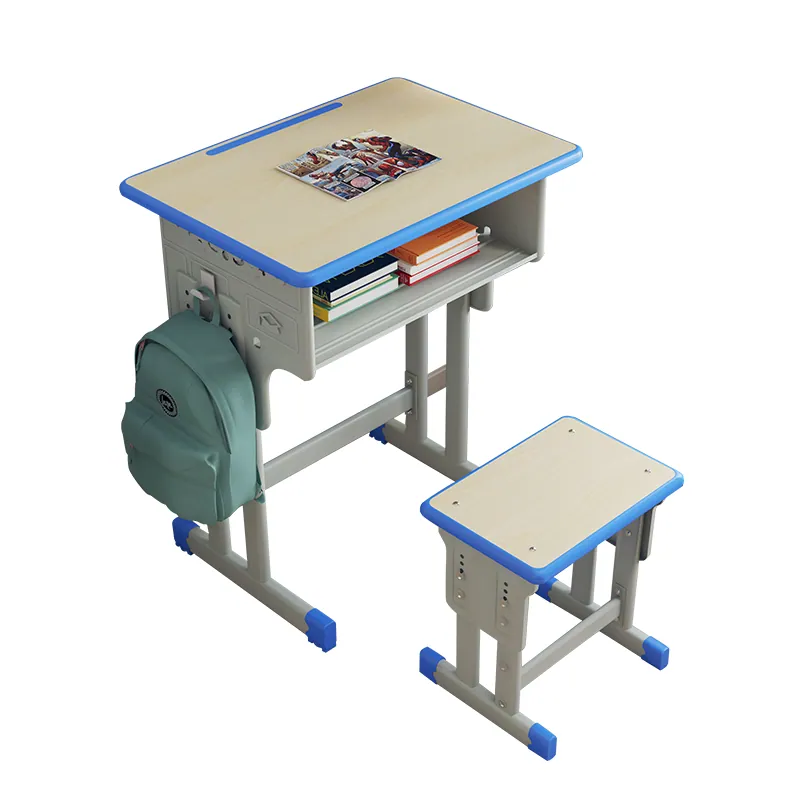
Three ways a school desk adjusts
Most adjustable school desks on the market use one of three systems.
Lift-up with a pin or hole pattern. The inner tube is drilled at intervals; a pin or bolt locks the height. It is simple, cheap to repair and very hard to break. The trade-off is granularity: you get the drilled steps, not a continuous range.
Hand-crank. A screw mechanism raises the desk or seat continuously. It suits home study desks and ergonomic school ranges where fine adjustment matters. More parts, more cost, and the crank needs to be stored where it will not disappear.
Sleeve-tube. One tube slides inside another and is clamped with a collar or bolt. It is common on cost-sensitive school ranges and easy to set at installation. The quality question is clamp force: a weak collar creeps down under load.
None of these is inherently better. A lift-up desk in a primary school and a hand-crank desk in a special-needs classroom are solving different problems.
The structural cost of adjustment
Every adjustable frame has a telescoping joint, and every joint is a place where rigidity is traded for range. Two things follow.
First, the tube wall and the overlap length matter more than the tube diameter on the catalogue page. A short overlap in thin tube will feel loose long before it fails.
Second, the locked setting has to survive load. Ask how the mechanism is secured, and whether the setting can be verified after installation. A desk that arrives at the right height and drifts down 20 mm in a term is worse than a fixed desk at the wrong height, because nobody notices.
What adjustable actually buys
Adjustable furniture earns its price in three situations.
A school that keeps furniture across year groups. One frame covers a range of pupils and can be re-set when rooms change. Fixed furniture has to be re-bought or re-sorted.
A tender that specifies multiple size marks. Instead of holding stock in every mark, the school holds one adjustable model and sets it per room. Fewer SKUs, less storage.
A market where stature is changing. If the pupil population is growing, fixed desks bought for today's average are the wrong size in five years.
It buys less when furniture never moves, when the school has clear size data and stable cohorts, or when the adjustable mechanism is the cheapest part of the desk.
The whole-life comparison, without invented numbers
You do not need a perfect model to make a better decision. You need four inputs from the school:
- Room count and pupil distribution — how many rooms, and how many pupils in each stature band.
- Replacement horizon — how long the school expects a set to last, and how it has replaced furniture in the past.
- Storage and handling — is there space to hold spare sizes, and who moves furniture between rooms?
- Labour cost of adjustment — who sets the heights, and when.
Then compare two plans: a fixed-furniture plan that buys the primary mark per room plus overflow, and an adjustable plan that buys one frame and sets it per room. Include the cost of holding and re-sorting fixed stock — that is the line most spreadsheets miss.
The adjustable plan usually wins on SKU count and loses on unit price. Whether it wins overall depends on how often the school re-sets rooms. A school that re-organises every year gets more from adjustment than one that has not moved a desk in a decade.
What to write into the tender
Adjustable furniture fails in procurement when the setting is left to installation day. A useful clause is specific:
Furniture shall be supplied set to the size mark specified in the room schedule, locked at that setting, and permanently marked with the size mark. The setting shall be verified at goods-in against the schedule.
That clause turns "adjustable" from a feature into a deliverable. It also gives the school something to check without a laboratory.
Three checks at goods-in
Set and lock one unit from each model. Follow the assembly instructions and check that the specified hardware is fitted correctly. Any load testing should use an agreed method, sample and acceptance criteria.
Measure the setting, not the range. The range on the catalogue is a capability. The setting in the room is the product. Measure seat height and table height separately, then compare the pair against the size mark.
Check the marking. A sticker falls off. Look for a moulded, stamped or etched mark. If the school is going to re-set furniture later, it also needs a simple height gauge or a printed setting guide — ask for one.
When fixed wins
Fixed desks are the right answer when the school has reliable size data, stable cohorts and no intention of moving furniture. They are also the right answer when the budget is fixed and the choice is between adjustable desks for half the rooms or fixed desks for all of them. A fixed desk that fits is better than an adjustable desk that does not arrive.
The mistake is not choosing fixed. It is choosing fixed by default, then discovering in year three that the school is short of two sizes and long on one.
If you are comparing the two for a tender, send us the room schedule and the size marks. We will quote both plans against the same specification, with the setting and marking included.